

-

MassCUE October News
It's time to head back to school with energy to spare! The October MassCUE Newsletter is here, packed with everything you need as the Fall Conference: Forward and Beyond approaches. Inside, you'll find step-by-step instructions for downloading the official conference app to build your personalized agenda, and a look at the 2026 MassCUE Award recipients who will be honored at Gillette Stadium on Oct. 14-15. We're also sharing keynote and speaker highlights, a preview of what's waiting between sessions, how to book your 1:1 Connection before spots fill up, and a reminder that Tech Director Luncheon registration closes Oct. 8 at 5 PM. Open the newsletter to get ready for the best two days of your school year. View the MassCUE News Want to get MassCUE news delivered right to your inbox? Sign up on our Newsletters page.
Continue reading -

Download the 2026 Fall Conference App
Get Ready for the MassCUE Fall Conference: Download the Event App! The MassCUE Fall Conference is just around the corner, and this year we're making it easier than ever to plan your day, find your way, and stay connected. Our official event app, available through Go Attend by Swoogo, puts everything you need right in your pocket. What You Can Do with the App With the app, you can browse the full session schedule and build a personal agenda that fits your interests and goals. You'll be able to find session rooms, exhibitors, and key locations without flipping through a printed program. Throughout the event, the MassCUE team will share real-time updates and announcements, so you'll always know what's happening and where. And because the Fall Conference is all about community, the app also helps you connect with fellow educators and presenters. How to Get Started Getting set up only takes a minute: Search for "Swoogo: Go Attend" in the Apple App Store or "Go Attend by Swoogo" in the Google Play Store. Download and open the app, then enter the email address you used to register for the MassCUE Fall Conference. Choose to receive a "magic link" by email, which logs you in automatically, or enter the password you created at registration. Your event will appear automatically. Tap it to build your schedule, explore exhibitors, and stay updated throughout the conference! Download It Before You Arrive We recommend downloading the app before the conference so you're ready to go on day one. Taking a few minutes ahead of time to look through the sessions and build your schedule means less time scrolling and more time learning once you walk through the doors. If you run into any trouble, such as registering with a different email address than the one on your phone, stop by the CUE Central desk and our team will be happy to help you get connected. We can't wait to see you at the MassCUE Fall Conference! But Wait, There's More! Register today! Visit our Registration page Why Attend MassCUE 2026? View our flyer “Top 10 Reasons to attend the MassCUE Fall Conference.” Stay organized and Plan Your Day! View our handy resource for planning your day at the Conference. Interested in Volunteering? Discover ways you can volunteer and earn discounted admission.
Continue reading -

Sign Up for MassCUE 1:1 Connections at the Fall Conference
Want some one-on-one time with an educational thought leader who gets it? Now's your chance. We're thrilled to bring back MassCUE 1:1 Connections at this year's Fall Conference on October 14-15 at Gillette Stadium. These focused, 15-minute conversations pair you directly with experienced mentors ready to share their expertise, answer your toughest questions, and help you walk away with ideas tailored to your goals. Whether you're looking to troubleshoot a classroom challenge, get feedback on an idea, or just build your network with someone who's been there, this is your moment to connect. Log in: Visit the MassCUE 1:1 connections scheduling Page here. You will need to use your registration credentials (username and password) to view this page and schedule a meeting. Browse mentors: Visit the MassCUE 1:1 Connections page to see our full lineup of mentors and find the right fit for you. Request your meeting: Found someone you'd love to connect with? Hit "Request Meeting," check out their availability, and pick a 15-minute time slot that works for you. You're booked! Once your mentor accepts, you're all set. Just show up ready to chat. Spots are limited and mentors go fast, so don't wait. Log in on October 1st and lock in your spot for some seriously valuable, one-on-one time with a mentor who can help move your work forward. See you in the Chill & Charge Area! But Wait, There's More! Register today! Visit our Registration page Why Attend MassCUE 2026? View our flyer “Top 10 Reasons to attend the MassCUE Fall Conference.” Stay organized and Plan Your Day! View our handy resource for planning your day at the Conference. Interested in Volunteering? Discover ways you can volunteer and earn discounted admission.
Continue reading -

Volunteer or Mentor at the Mark Cuban Foundation AI Bootcamp This Fall
The Mark Cuban Foundation is looking for volunteers and mentors for three Saturday AI Bootcamps this fall The Mark Cuban Foundation is seeking volunteers and mentors to work directly with high school students as they explore artificial intelligence at a free, hands-on Saturday bootcamp in the Boston area. What Is the AI Bootcamp? The AI Bootcamp is a free program for high school students (grades 9 through 12) that introduces them to AI through hands-on activities, career exploration, and a student-designed capstone project. Students choose a track based on their interests, including AI in Entrepreneurship, Sports and Fitness, Arts and Entertainment, Computer Science, Healthcare, and Ecology and Food Security. No prior computer science experience is required for most tracks. The bootcamp runs on three consecutive Saturdays: October 31 November 7 November 14 Sessions run from 11:00 AM to 4:00 PM ET. Volunteers and mentors are asked to arrive 30 to 60 minutes early depending on their role. How You Can Help? There are two ways to get involved: Mentors are paired with the same small group of students throughout the program (a 1:4 to 1:6 mentor to student ratio). Mentors do not need to teach or deliver any content. Instead, they facilitate conversations, offer perspective, ask questions, and share their own experiences to support students as they work through activities and build their capstone project. Mentors are encouraged to attend all three sessions to build continuity with their group. Volunteers play a flexible, hands on support role, helping with things like food setup, room setup and breakdown, and general logistics for students and mentors. Volunteers are welcome to sign up for one day or all three. No AI background is required for either role. You might just learn something too. Training and Support All volunteers and mentors complete a required, self-paced online training (about one hour) before the bootcamp, with access opening in October. A live training session is also available on Wednesday, October 21 from 10 to 11 AM for anyone who wants extra support. The Mark Cuban Foundation is also hosting optional drop-in office hours the Friday before each bootcamp day for last-minute questions: Friday, October 30, 10 AM to 12 PM Friday, November 6, 10 AM to 12 PM Friday, November 13, 10 AM to 12 PM Register Today Ready to make a difference for the next generation of AI leaders? Register as a volunteer or mentor. REGISTER Want to learn more first? Check out the volunteer and mentor overview document for full details on each role or watch this video. Questions? Reach the Mark Cuban Foundation team at volunteers@markcubanai.org.
Continue reading -

Fall Conference 2026: Celebrate our Award Winners
MassCUE is pleased to announce the recipients of the Administrator, Pathfinder and Shelley Chamberlain Community Service Awards. Please join us in congratulating these extraordinary educators and leaders. They will be celebrated and receive their awards as part of the MassCUE Fall Conference 2026. Jacqueline Marie Collins, Business & Technology Teacher, Mansfield Public Schools After serving as a Discovery Education STEM Fellow in Washington, D.C., Jacqueline Collins began weaving STEM experiences into her business classes, helping students see technology as a tool to solve problems and bring ideas to life. She founded the Computer Science Club at Mansfield High School, secured funding for students to attend the Statewide STEM Summit for Girls, and was a Massachusetts STEM Teacher of the Year finalist in both 2016 and 2017. Believing students learn best by doing, Jacqueline transformed her classroom into a makerspace and entrepreneurship program where students run real businesses from start to finish, researching, prototyping, marketing, and selling products before donating profits to local charities and Kiva. Since the program began, students have donated more than $19,000. What started as a single section has grown to six, all now part of Massachusetts' Early College initiative, allowing students to earn college credit in high school. A longtime believer that the best ideas are meant to be shared, Jacqueline co-founded Edcamp Southeastern Massachusetts and served on the MassCUE Board of Directors for ten years, including four terms as Treasurer. She co-authored her district's Responsible Use Policy and the 2021 National Standards for Personal Financial Education, and has testified at the State House in support of financial literacy legislation, extending her impact well beyond her own classroom. Elizabeth Voci, Instructional Technology Specialist, Dartmouth Public Schools Liz Voci has been a driving force behind educational innovation in Dartmouth Public Schools, helping teachers embrace digital tools as essential components of meaningful instruction rather than add-ons. Her vision has fostered a culture where innovation is encouraged and risk-taking is supported, making her a catalyst for technological change across classrooms, schools, and the district as a whole. Liz stays at the forefront of emerging technologies, from AI-powered tools to Vibe Coding, and openly shares her successes and lessons learned through presentations, networking, and social media. As a Google Certified Innovator and Champion, she trains districts on Google AI tools, runs a podcast highlighting other Google innovators, and leads an innovator program, consistently shining a light on others' work over her own. What sets Liz apart is her commitment to helping others see what is possible. Whether mentoring educators, presenting at conferences, or supporting authentic STEM experiences for students, she has built a reputation as a connector and collaborator who freely shares her knowledge so others can succeed, embodying the Pathfinder spirit of charting new paths and bringing others along the journey. Ryan Robidoux, Director of Learning and Innovation, Mendon-Upton Regional School District Ryan Robidoux has established a forward-thinking standard for safe, ethical, and adaptable technology adoption in his district. Rather than approaching AI through restriction, he proactively designed and implemented human-centered AI guidelines, developed through the PEAK program, that prioritize student and teacher agency and position AI as a tool for critical thinking and creative expression. He has modeled this vision by leading workshops across Massachusetts that demystify AI while grounding every application in data privacy, academic integrity, and critical thinking. Ryan has also driven actionable equity in daily instruction. He built dashboards that elevate qualitative insights alongside traditional metrics, inviting students to document and reflect on their own learning journeys in alignment with the district's Portrait of a Learner. He conceptualized and developed the DCAP Planning for All Learners (PAL) tool, which allows educators to input student needs and instantly receive tailored accommodation strategies, streamlining Tier 1 instructional planning and helping ensure every student receives equitable support. His impact extends well beyond district borders. As a member of the inaugural PEAK cohort, the DESE AI Task Force, and the MA AI Hub educational working group, Ryan helps shape statewide policy and practical frameworks for AI integration, regularly translating that work into conference presentations for educators across the state. As Co-President of the CSTA Massachusetts Chapter, he also models national-level advocacy for equitable computer science education. Gail Ross-McBride Gail Ross-McBride's work has never been about technology, but about what technology makes possible for students. She began her career instructing underachieving students in Weymouth and students with learning disabilities in Cambridge, where she developed a passion for technology and launched the groundbreaking School of the Future for Cambridge Public Schools. She was later chosen to represent the United States in a U.S.-U.K. partnership designing technology-based learning resources, and she helped establish a new state certification for Instructional Technology Specialists through her work with DESE's advisory group. Gail joined MassCUE as its first Vendor Coordinator for the 1986 Wellesley conference, later serving as Conference Chair and Vice President. She coordinated the Kids and Computers program, which received a citation from Governor William Weld, and went on to lead emerging technology initiatives at The Education Cooperative and EdTechTeacher. Gail retired this past April but continues to volunteer with MassCUE. Her quiet, determined leadership over four decades has paved the way for countless educators across Massachusetts. Jim Flanagan, Executive Director, METAA (Massachusetts Educational Technology Administrators Association) Jim Flanagan has been an enthusiastic advocate for educational technology for decades, working behind the scenes to promote change in the field. He served as Chief Operating and Strategy Officer at ISTE before taking on his current role at METAA, where he brings together technology directors and leaders across Massachusetts to promote teaching and learning with technology. Jim's influence spans national and state levels. He supported DESE's Department of Educational Technology during the pandemic and helped launch single-district virtual schools, and he has volunteered as a member of the Chicago Board of Education and Treasurer of the TECCA Board. He remains active in MassCUE's Influence and Advocacy Committee and the SCITT special interest group for Southeast Coast, Cape, and Islands Technology Coordinators, consistently showing exceptional leadership in advocating for better education through technology.
Continue reading -

What’s New in 2026 at MassCUE Fall Conference
There’s even more to discover at the MassCUE Fall Conference 2026! This year, we’re bringing exciting new experiences designed to spark creativity, encourage connection, and showcase what’s next in education. From hands-on learning and innovative technology to live conversations and creative experiences, these new additions offer even more ways to explore, engage, and get inspired throughout the conference. Get ready to experience Fall Conference in a whole new way! CAST UDL-CON Explore Universal Design for Learning with CAST and discover practical strategies and technology tools that create more flexible, accessible, and inclusive learning experiences for every student. Tech Department Future Ready Office sponsored By Avidex Step into the Future-Ready Technology Department Sponsored by Avidex to explore the latest solutions in cybersecurity, network management, device management, communications, system access, and more—all designed to help school technology teams work smarter and more securely. Drawn Together Hub: The Doodle Booth Experience Step inside Manuel Herrera’s Doodle Booth, share an idea or classroom inspiration, and watch as he transforms your conversation into a personalized illustrated portrait that captures both you and your thinking. G-P Atrium Stage Stop by the G-P Atrium Stage hosted by Carl Hooker for an energetic lineup of educator panels, student Ignite sessions, spotlight speakers, and interactive conversations exploring topics like AI, STEM, cybersecurity, literacy, student voice, career pathways, and the future of education. Gym for the Brain Sponsored by Knowt Recharge and reset at the Gym for the Brain sponsored by Knowt, an interactive space featuring hands-on STARR exercises designed to support focus, regulation, and resilience. Explore practical strategies for mental health, digital wellness, and overall well-being developed by #SameHere that you can use personally and bring back to your school community. AV Support provided by Touch View and furniture provided by MooreCo. But Wait, There's More! Register today! Visit our Registration page Why Attend MassCUE 2026? View our flyer “Top 10 Reasons to attend the MassCUE Fall Conference.” Stay organized and Plan Your Day! View our handy resource for planning your day at the Conference. Interested in Volunteering? Discover ways you can volunteer and earn discounted admission.
Continue reading -

CAST UDL-CON at MassCUE
MassCUE and CAST are shaping a future where innovation and inclusion go hand in hand. Located on the Red Level South East Mezzanine, CAST UDL-CON brings educators and administrators together for two days of inspiring sessions, hands-on learning, and meaningful collaboration centered on Universal Design for Learning. Explore practical strategies, resources, and ideas designed to make learning more flexible, accessible, and inclusive for every learner. Build Learning With Everyone in Mind Explore UDL strategies that proactively remove barriers and create more flexible learning experiences. Expand Access for Every Learner Discover ways to support accessibility, multilingual learners, executive function, and diverse learning needs. Learn With the UDL Community Collaborate with educators, administrators, CAST leaders, and fellow conference attendees. Turn UDL Into Practice Leave with practical tools and approaches you can bring back to classrooms, schools, and district Sessions on Wednesday, Oct. 14 Session 1: Designing for Success: Leveraging UDL to Strengthen Executive Function Skills Session 2: AI Meets UDL: Rethinking Access and Learning Design Session 3: Accessibility and AI in Action: Smarter Tools for Inclusive Learning Session 4: UDL Whole School: Aligning People, Practice and Purpose Sessions on Thursday, Oct. 15 Session 5: Inclusive Leadership in Action Session 6: Centering the Multilingual Learner Experience Session 7: Teacher and Student Voices on UDL and Inclusive Practices Session 8:Designing for Healing and Access: Integrating UDL and Trauma-Informed Practices But Wait, There's More! Register today! Visit our Registration page What Not to Miss? Explore all the special areas at the Fall Conference Who is Speaking? Explore the sessions Why Attend MassCUE 2026? View our flyer “Top 10 Reasons to attend the MassCUE Fall Conference.” Have a question? Explore our attendee FAQ Interested in Volunteering? Discover ways you can volunteer and earn discounted admission.
Continue reading -

Fall Conference: CueKids Showcase
Get ready to see innovation through the eyes of students at the CUEKids Student Showcase! Located in the G-P Atrium, this high-energy experience puts K–12 students in the spotlight as creators, problem-solvers, and leaders, sharing how they’re using technology to transform learning in their classrooms. Explore interactive showcase tables, catch fast-paced IGNITE-style presentations, and connect directly with students and educators while discovering fresh ideas and inspiration from schools across the region. Future Makers: Coding & Engineering Grades 5–8 Coding Club students will bring creativity and technology together through interactive projects featuring coding, robotics, lights, movement, and sensors. Using tools like Hummingbird Robotics Kits, imagi Charms, and micro, students will demonstrate their creations and share how collaboration, problem-solving, and computational thinking brought their ideas to life. Integrating Computer Science In Elementary Science Classes K–5 students from Beal Elementary School will showcase how they’re applying computer science and computational thinking to their science learning using the CSforALL curriculum. Through hands-on examples, attendees will see how coding and technology can be integrated into existing curriculum while giving students creative new ways to explore concepts and demonstrate their learning. Student Voices In STEM: Interactive Dioramas Student presenters will showcase how they transformed traditional science dioramas into interactive, robotics-enhanced STEM experiences focused on endangered plants and animals. Attendees can explore student-created habitats and robotic monitoring devices while learning how coding, engineering, creativity, collaboration, and problem-solving can bring science learning to life. Books and Microbits Students will showcase creative Micro projects that bring coding, literature, art, and real-world problem-solving together. From interactive games and light and sound pollution sensors to book-inspired character displays, students will demonstrate their creations and share the process behind their coding, data collection, and design. Creating A Student Run Broadcast Using AI and Canva Students will showcase how AI and Canva can bring a schoolwide morning broadcast to life, from brainstorming and scriptwriting to visuals, video, and storytelling. Attendees will discover how student-led broadcasting builds communication skills, amplifies student voice, and encourages responsible, creative use of AI and digital tools. The Journey of Bringing an Information Technology Vocational Program into an Academic High School Students and educators from Springfield Central High School will showcase the evolution of their vocational Information Services and Support Networking (ISSN) program. Through student experiences and live demonstrations, attendees will see skills in computer maintenance, repair, networking, and certification-focused training while learning how the program has grown from an idea into a pathway for future technology professionals. Family Partnerships in STEM & Student-Led Innovation Elementary students, parent volunteers, and educators will showcase how family partnerships can strengthen Digital Literacy and Computer Science (DLCS) learning. Through coding, robotics, digital creation, and computational thinking activities, attendees will see how volunteers help students collaborate, problem-solve, and build confidence while discovering ideas for creating similar partnerships in their own schools. Opportunity Box: Using Digital Fabrication Tools To Solve Community Needs Students from The Meadowbrook School will showcase their Opportunity Box, a student-driven initiative that transforms real community needs into creative solutions. Using design thinking and digital tools like 3D printers and CNC routers, students will share how they research, design, test, and refine their ideas while demonstrating how authentic problem-solving can build student agency and make a meaningful community impact. Go West! Interactive Board Game Students will bring history to life through a digitally interactive board game inspired by westward expansion.Combining social studies, math, ELA, coding, 3D prototyping, and design thinking, attendees can experience the student-created game firsthand while exploring how storytelling, probability, and hands-on problem-solving make learning more engaging. Beyond the Prompt: Real Student Uses of AI Fifth-grade students will share how they’re using AI to support research, creativity, projects, and everyday learning. Through real classroom examples—including AI-generated images, reading responses, personalized feedback, podcasts, and interactive activities—attendees will hear directly from students about how AI can be integrated meaningfully and responsibly into the classroom. Math Is Money Fourth-grade students will showcase how they use a MUSE laser etcher to turn digital designs into precisely crafted creations, from analog clocks to charcuterie boards. Attendees will learn how students collaborate using design software, templates, measurement tools, and mockups to plan projects, create accurate cuts, and bring their ideas to life. SVU Fact-Checking, SIFTing, and Solving in Today's Digital World Students will showcase how they use the SIFT method to investigate online claims, AI-generated content, and misinformation like digital detectives. Through interactive activities such as “Fact or Fake?” and real-world investigations, attendees will discover engaging ways to build media literacy, critical thinking, and responsible information-verification skills. Unfiltered: What 5th Graders Really Think About Screens and School Fifth-grade students will take the stage to share their perspectives on screens, AI, learning, and digital life at home and at school. Through a student-led panel and interactive conversations, attendees will hear directly from today’s learners and gain valuable insight into how technology shapes their experiences, habits, and education. But Wait, There's More! Register today! Visit our Registration page What Not to Miss? Explore all the special areas at the Fall Conference Who is Speaking? Explore the sessions Why Attend MassCUE 2026? View our flyer “Top 10 Reasons to attend the MassCUE Fall Conference.” Have a question? Explore our attendee FAQ Interested in Volunteering? Discover ways you can volunteer and earn discounted admission.
Continue reading -
MassCUE September News
It's time to head back to school with energy to spare! The September MassCUE Newsletter is here, packed with everything you need as the new school year gets underway. Inside, you'll find that registration is officially open for the Fall Conference: Forward and Beyond at Gillette Stadium, plus a chance to win Patriots tickets if you register by Sept. 21. We're also sharing the full keynote and speaker lineup, details on the Tech Director Luncheon, only five spots left in PEA²K Cohort 2, and a last chance to grab MassCUE membership at $35 before it goes up on Sept. 15. Open the newsletter to stay informed and inspired as we kick off the new year together. View the MassCUE News Want to get MassCUE news delivered right to your inbox? Sign up on our Newsletters page.
Continue reading -

Check Out the Bookstore and MassCUE Shop!
SHOP NEW MassCUE Fall Conference 2026 Gear! JOIN THE MASSCUE COMMUNITY IN STYLE! Get ready for Fall Conference 2026 and show off your MassCUE spirit! The MassCUE Shop is your chance for official conference gear and MassCUE favorites. Whether you're looking for a T-shirt or cozy sweatshirt to wear at the conference, a tumbler to keep your favorite drink close by, or a tote to carry all your conference essentials, there’s something for everyone. Shop ahead, find your favorites, and arrive at Fall Conference ready to represent the MassCUE community in style!Items can be ordered through the online Fall Conference pop-up shop before, during, or after the conference, so you can bring a little MassCUE spirit home with you! SHOP THE 2026 COLLECTION: See More A Must-Visit Stop at Fall Conference! Your Next Great Read Starts Here! The MassCUE Bookstore is a great place to browse books from presenting authors and connect with educators and leaders shaping the future of educational technology. Attendees can also meet featured authors during scheduled book signings, making it the perfect opportunity to discover a new read and connect with the people behind it. But Wait, There's More! Register today! Visit our Registration page What Not to Miss? Explore all the special areas at the Fall Conference Why Attend MassCUE 2026? View our flyer “Top 10 Reasons to attend the MassCUE Fall Conference.” Have a question? Explore our attendee FAQ Interested in Volunteering? Discover ways you can volunteer and earn discounted admission.
Continue reading -
Get Ready for the Future Ready Librarians Court
Step into the Future Ready Librarians Court a dedicated space to learn, network, and grow alongside colleagues who share your passion for transforming libraries and schools. Explore the latest ideas, strategies, and tools for leading in a changing educational landscape. Through inspiring sessions, fireside chats, and collaborative conversations, you’ll discover ways to strengthen literacy, advocacy, AI readiness, media literacy, digital citizenship, collaboration, and leadership in your library and school community. Speakers from across Massachusetts will also join the Court, bringing their expertise, perspectives, and leadership to this vibrant learning community. The Future Ready Librarians Framework 3.0 Dive into the latest framework and discover how it can support the evolving role of librarians. Innovate & Empower Gain strategies to lead change, embrace innovation, and empower students and teachers. Build Your Community Network with fellow librarians and educators, exchange ideas, and share best practices. Take Ideas With You Leave with practical tools, strategies, and resources you can bring back to your library and school community. Shannon McClintock Miller Shannon McClintock Miller is an international speaker, author, consultant, and district teacher librarian who serves as the Future Ready Librarians® Leader, connecting and inspiring librarians, educators, and students around the world. An award-winning advocate for school libraries and education, she is also the author of The Library Voice blog and numerous children’s and professional books. Lia Dossin Lia Dossin is the Director of Programming & Outreach at All4Ed, where she supports digital planning and implementation for the Future Ready Schools® initiative. With experience as a classroom teacher, technology trainer, and library media specialist, Lia brings a unique perspective to helping educators build innovative, connected, and future-ready learning communities. Session 1: Future Ready Librarians 3.0 Year 2 Growing as Leaders in AI, Literacy, Advocacy, and More! Lia Dossin Shannon McClintock Miller Session 2: Wired for Bias Why Our Brains and Our Bots Get It Wrong Jessica Garbowski Session 3: Year 20, Day 1 The Program I Built — and What Every Educator Can Learn From Starting Over Jen Thomas Session 4: Empowering Digital Citizens Media Literacy and Critical Thinking in the Age of EdTech Lia Dossin Shannon McClintock Miller Session 1: Future Ready Librarians 3.0 Year 2 Growing as Leaders in AI, Literacy, Advocacy, and More! Lia Dossin Shannon McClintock Miller Session 2: Collaboration The Future Ready Librarians Superpower! Shannon McClintock Miller Session 3: Empowering Digital Citizens Media Literacy and Critical Thinking in the Age of EdTech Lia Dossin Shannon McClintock Miller Session 4: Prioritizing Information Literacy In Elementary Learning Spaces Laura Hubert But Wait, There's More! Register today! Visit our Registration page What Not to Miss? Explore all the special areas at the Fall Conference Who is Speaking? Explore the sessions Why Attend MassCUE 2026? View our flyer “Top 10 Reasons to attend the MassCUE Fall Conference.” Have a question? Explore our attendee FAQ Interested in Volunteering? Discover ways you can volunteer and earn discounted admission.
Continue reading -

Fall Conference: What’s Happening In The G-P Atrium
There’s More to Explore in the G-P Atrium Discover hands-on learning, student innovation, live conversations, creative experiences, and spaces to connect and recharge. The G-P Atrium is one of the most interactive spaces at the MassCUE 2026 Fall Conference, Throughout both days of the conference, attendees can explore emerging technologies, hear from educators and students, participate in engaging activities, and discover ideas they can bring back to their schools and districts. G-P Atrium Exhibitors Explore hands-on demonstrations featuring STEM, and robotics, AI-powered learning tools, CTE resources, and emerging classroom technologies. Educator Playground Get hands-on with tools, strategies, and activities covering AI, Computer Science, Digital Literacy, STEM, Accessibility, Leadership, and Universal Design for Learning. CUEKids Showcase Meet K–12 students as they demonstrate innovative projects involving AI, coding, engineering, STEM, broadcasting, digital fabrication, and more. G-P Atrium Stage Stop by the G-P Atrium Stage, hosted by Carl Hooker, a visionary in education known for his groundbreaking work on leadership, innovation, and digital balance. Join live panels, and spotlight speaker sessions covering AI, cybersecurity, data privacy, career pathways, and other important topics shaping education. Live Podcasting Booth Get a CUE Podcast host Brandon Hall and Stronger Together Podcast host Dr. Matthew Joseph will be joined by presenters throughout the conference to take a deeper dive into some of the topics facing educators and educational technology today. Listen in on live interviews with keynote speakers, presenters, and conference guests discussing EdTech, leadership, innovation, and their biggest conference takeaways. MassCUE 1:1 Connections Sit down for a focused 15-minute conversation with an educational thought leader to discuss a question, challenge, or idea and receive personalized insight. Drawn Together Hub: The Doodle Booth Experience Step inside Manuel Herrera's handmade doodle booth, share an idea or classroom hope, and watch it come to life through a personalized illustrated portrait. Chill & Charge Lounge Take a break, charge your devices, grab coffee, water, or a light snack, and connect with fellow attendees before heading to your next conference experience. Gym for the Brain Sponsored By Knowt Recharge with interactive activities developed by #SameHere Global focused on emotional regulation, resilience, focus, and digital well-being. AV Support is provided by Touch View and furniture is provided by MooreCo. But Wait, There's More! Register today! Visit our Registration page What Not to Miss? Explore all the special areas at the Fall Conference Who is Speaking? Explore the sessions Why Attend MassCUE 2026? View our flyer “Top 10 Reasons to attend the MassCUE Fall Conference.” Have a question? Explore our attendee FAQ Interested in Volunteering? Discover ways you can volunteer and earn discounted admission.
Continue reading -
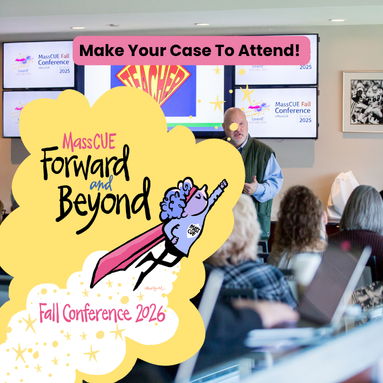
Make Your Case to Attend the MassCUE Fall Conference
MassCUE Fall Conference: Make Your Case to Attend! The MassCUE Fall Conference returns to Gillette Stadium on October 14–15, 2026 — and this year, we're thinking bigger than ever. Mark your calendar for New England's premier education technology conference, where this year's theme, Forward and Beyond, sets the tone for two days of bold ideas, meaningful connection, and transformative learning. Forward and Beyond builds on last year's momentum and challenges us to push past limitations — to reimagine not just what we do in education, but what education can become. In today's dynamic edtech landscape, moving forward means integrating impactful tools, advancing inclusive practices, and amplifying student voice. Going beyond means transforming systems, deepening equity, and designing learning experiences that prepare students for a rapidly evolving world. Look Forward to: Receiving practical and classroom-ready resources, templates, and strategies you can apply immediately. Investing in your career through professional learning benefits like PDPs, practical tools, and generative sessions. Finding a fresh perspective on on how to engage with students in today’s tech world through student-led panels and showcases. Experiencing learning environments like interactive playgrounds and esports arenas, designed to surprise and delight Visit our website and check out the following resources we’ve made to help you convince your district to invest in your potential at the Fall Conference: Make Your Case to Attend the Conference
Continue reading -

Fall Conference 2026: Tech Director Luncheon
You're Invited: Tech Director Luncheon at the MassCUE Fall Conference Get your Fall Conference off to a strong start by joining fellow tech leaders for an exclusive Tech Director Luncheon on Wednesday, October 14, 2026, at Gillette Stadium. This intimate gathering is designed specifically for Tech Directors attending the MassCUE Fall Conference. It's your chance to connect with peers who understand the unique challenges of leading technology in schools and districts across Massachusetts, swap ideas with colleagues facing similar priorities, and meet MassCUE and METAA Board Members along with our Corporate Partners, all in a smaller, more personal setting before the conference gets into full swing. Event Details Who: Tech Directors attending the MassCUE Fall Conference Hosts: MassCUE and METAA Where: Gillette Stadium, East Side, B10 When: Wednesday, October 14, 2026, 12:00pm to 1:00pm Registration Space is limited. The luncheon is capped at 50 attendees, with one seat reserved per district, so we encourage you to RSVP early. Registration is required by Thursday, October 8, 2026 at 5:00 PM. Please note that the lunch served will match the lunch provided to all conference attendees. RSVP for the Tech Director Luncheon Why Attend This luncheon gives Tech Directors a rare opportunity to step outside the usual conference pace and have real conversations. You'll network with: Fellow Tech Directors from districts across Massachusetts MassCUE and METAA Board Members Corporate Partners who support the work you do every day It's a great way to build relationships early in the conference that can carry you through the rest of your time at Gillette Stadium. More for IT Professionals Looking for sessions tailored to your role? Check out our Fall Conference Flyer designed for IT Professionals, featuring sessions curated in collaboration with METAA to provide targeted learning for Tech Directors and IT staff. Bookend the luncheon with related sessions offered at 11:00am to 11:50am and again at 1:15pm to 2:05pm, so you can make the most of your day. Questions? For any questions or cancellations, please reach out to info@masscue.org.
Continue reading