

-
Learner Variability Takes Center Stage at Barnstable High School
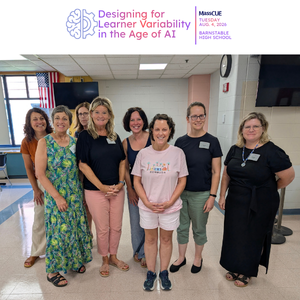
Learner Variability Takes Center Stage at Barnstable High School Educators from all over gathered at Barnstable High School for MassCUE’s Designing for Learner Variability in the Age of AI mini-conference on Aug. 4, 2026, and the energy in the building said it all. From learner-centered practices to instructional design basics to executive function and SEL strategies, the day was packed with ideas educators could put to use the very next day in their own classrooms. Attendees left with fresh strategies for designing learning experiences that meet students where they are, and with a shared reminder that when we design for learner variability, we design for belonging. MassCUE is proud to support educators leading the way in inclusive, learner-centered design, and we're just getting started. Special thank you to all of our presenters. Sessions Included: Re-Thinking Literacy: Print, Digital and AI Successfully Converge — Brett Pierce A model for re-balancing print and digital writing practices, integrating AI to expand student dialogue and make literacy more inclusive for the many students for whom print is not their primary means of communication. What If the Problem Isn't the Student? Designing Classrooms that Support Regulation, Belonging, and Learner Success — Dr. Anne Katona Linn Practical strategies for classrooms that strengthen self-regulation, executive functioning, engagement, and belonging, so every learner feels seen and capable of success. Beyond Leveling: Using AI to Bridge the Gap to Complex Text — Edward Jacques, Sarah Hopson Concrete ways to use generative AI to build scaffolds that let all students engage directly with complex, grade-level text rather than simplified versions of it. Notice First: Self-Awareness as the Foundation for AI Literacy — Jacqui Heron Finn A framework for building the self-awareness that turns AI into a genuine thinking partner in the classroom, starting with a personalized learner profile participants build for themselves. AI as your New "Administrative Assistant": Leveraging AI to Improve Executive Functioning Skills in Secondary Classrooms — Joshua Dickson A hands-on look at how generative AI can help secondary students break down assignments, build action plans, and grow more independent learners. Using AI to Expand Access and Voice in Math — Karen Levin Grounded in UDL and NCTM research, this session explores when AI genuinely opens up access, participation, and voice in math class, and when it gets in the way. The Future of Literacy Is Flexible: Designing Reading and Writing in the Age of AI — Karen Janowski Practical strategies for designing more flexible, inclusive literacy instruction that honors the Science of Reading while embracing what AI makes newly possible. Unlocking Student Agency through Practical AI Supports — Vanessa Miller, Sarah Dully, Melissa O'Neill, Kristen Provost Real classroom examples of AI tools like Read&Write and NotebookLM reducing barriers and helping students work more independently toward grade-level learning. Designing Instruction That Promotes Independence: AI as a Cognitive Support — Karen Janowski A look at how AI can function as a cognitive support, not a replacement, helping learners strengthen executive function, comprehension, and organizational skills through intentional instructional design. Designed for All: Using AI to Build Flexible, Rigorous Learning Experiences — Heather Sweet Strategies for using AI to differentiate at every stage of instruction, from surfacing prerequisite knowledge to building choice boards and tiered assignments. Using Interactive Panels to Improve Engagement and Accessibility — Paul Hickey A look at how interactive panel design, hardware and software alike, is driving improvements in classroom equity and inclusion. Empowering Inclusivity: Support All Learners with Lumio — Sarah Storck How Lumio's built-in and AI-powered tools, from Immersive Reader to real-time content adaptation, help create more equitable, personalized learning. Beyond the Prompt: Teaching Students to Be Safe, Smart, and AI Ready — Suzanne McLaughlin Practical strategies for building cybersecurity awareness, digital citizenship, and AI literacy so students can navigate an AI-powered world safely and critically. Want More Days Like This One? Days like this are only possible because of educators like you who show up, share ideas, and push the work forward. If you want to stay connected to opportunities like Designing for Learner Variability, become a MassCUE member and sign up for our newsletter so you never miss what's coming next. Designing for Learner Variability in the Age of AI Sponsors A special thank you to our generous sponsors who made this event possible: Avidex, Brisk Teaching, Custom Computer Specialist, and Ockers Technologies.
Continue reading -

Learning and Unlearning: My 5 Key Takeaways from ISTELive 26 + ASCD
This post was written by Tracy Sockalosky, President of MassCUE Truth be told, I have avoided this conference for many years, it always felt too overwhelming for me. I am really glad that this year I took the plunge and made the trip. And I am so grateful that I am lucky enough to call the two best ISTE sherpas my friends, so thanks to Rayna Freedman and Kim Zajac, I arrived in Orlando with a full itinerary and the appropriate wardrobe ready to connect and learn. The experience did not disappoint. Reflecting on the experience, I share my five key takeaways. 1. There is no such thing as the end of the learning journey in education. Just kicked off year five as an administrator after more than 20 years as a classroom teacher. I can say with certainty that I still have so much to discover in my quest to create and support learning environments that meet the needs of our students. Sure my toolbox and knowledge base have grown considerably from where they began, but sitting in sessions, exploring the playgrounds, listening to ideas shared by other educators all confirmed that there is so much possibility in the future of education and I need to be open to learning AND unlearning in order to fulfill our promise to kids. In one 1-hr panel session I scribbled a full page of notes, searched 27 different ideas, authors, companies, tools mentioned and am now going to go back and rewatch the video because I know I missed things. And that was only one session. The experience had ideas spinning about ways to reach students in new ways from Starr Sackstein and Michael MacDowell’s simple but powerful “dot strategy” to the possibilities Tim Needles shared with his experience in the NASA Solar System Ambassador program, to ways to be more efficient in my own work (Google Classroom updates are fantastic!) and ideas to explore further with my colleagues (two that stand out for me are Snorkl and OKOlabs). As educators, when we pause and take the time to listen, when we allow ourselves to be vulnerable, we accept that we still have so much to learn and that will not change regardless of how long we continue to dedicate ourselves to education. 2. “Tech” is not the problem and bans are not the answer. As expected, a theme of many sessions was the current tech backlash. The panelists for the session “Effectively Navigating Tech Backlash” encapsulated my thoughts far more succinctly and articulately than I could so I share some of their thoughts here: Amber Oliver: “We are missing the forest through the trees by not talking about the fact that our kids aren’t reading. Twenty-five percent of our kids are missing, not coming to school, feeling like it isn’t relevant to them. That’s the conversation teachers want to have. How do we show up and make sure that we are doing what is needed for kids? And we need every tool in the tool box to do that.” Jeff Livingston: “The kids who get into my house are going to get all they need. I’m going to make sure. But we work for kids who don’t live in houses like mine, and we owe it to ourselves to make sure that we are doing what is right for them today and in their future.” Beth Rabbitt: “One piece of the narrative we have to talk about a bit more is our responsibility…to preparing our kids to be the ones who are using these technologies…I don’t know if anyone knows this but scientists in March embedded 200,000 human brain cells on a chip, and that chip learned how to successfully play the video game “Doom.” We don’t know what our kids are going to be facing. So the most important thing we can focus on is helping them be great learners and really critical consumers, and they’re not going to do that on their own.” Brandon Olszewski: “There is no research out there that shows well-built technology, implemented well, hurts academic, personal or social outcomes. It’s not true. We’re thoughtfully considering exactly how, where and when technology can help our students and teachers, especially those students that are trying to learn English and thrive in this world, and the students on 503s…And there is no engineering school who wants a student who learned how to use the abacus in high school…” 3. We still have work to do for our students, especially those who are historically underserved. My first job in education was serving as the skills instructor for students enrolled in the METCO program at Curtis Middle School in Sudbury, MA. My second was 8th grade US History teacher at Carroll School, a school dedicated to the education of students with dyslexia. Suffice to say that my passion is educating students who are often lost in public education and has been for more than 25 years. And though there have been improvements, a quick scan of assessment data of even the most high-achieving districts in my state reveals that these students are still in the margins rather than thriving alongside their classmates. In 2005 I had the privilege of learning about UDL from David Rose himself, and yet more than 20 years later there are still sessions introducing educators to the concept. I was thrilled to listen to the amazing team of educators from CAST but it also reminded me that we still have so far to go to create educational opportunities that are inclusive for all learners. Two questions posed by our own extraordinary Karen Janowski during her session continues to resonate with me: “Would I want to participate in this learning experience? Does the environment (curriculum AND learning space) reflect the learners?” 4. Assessment must be a focus of every educator. What I knew before this week and what I am 100% confident of now - we MUST discuss assessment in our classrooms. Starr Sackstein and Michael McDowell’s session on Actionable Assessment got my wheels spinning even more. Their premise is that the most essential assessment in a classroom is the ongoing feedback students receive. According to their research, 80% of feedback received is from their peers and 80% of that feedback is incorrect; therefore, we must make feedback clear and actionable so that students have clarity about what they understand and can replicate beyond the moment. The ideas and practical strategies they shared had me yearning to be back in the classroom to use with students. None of them were earth-rattling, but each powerful for student learning and a reminder that “if students lack clarity, it's not teaching, it is tutoring.” I am still thinking about a statement about a dilemma that Indiana University professor, Joseph Baird, shared on a panel titled “What If Everything We Know About Assessment Is Wrong?“ In speaking about his observation of his students he shared, “They think everything is an instance instead of a pattern. They think that they need to solve a single problem with a single output in order to answer what's the answer to this problem. But what they don't quite see yet is this problem they're trying to solve is actually an instance of a type of problem, and that those types of problems are instances of even broader types of problems.” To me this exemplified my concern about assessments in secondary schools today: what are we actually assessing and is it what we should be assessing? The whole panel conversation, which also included Josh Caldwell from Google, Isabelle Hau the Executive Director of the Stanford Accelerator for Learning, educator and author Michael Hernandez, and Brooke Stafford-Brizard from Carnegie Foundation, was thought-provoking. In the session about tech backlash, Beth Rabbit, Co-CEO of FullScale, shared that she is working to build a public school system in Maine that is competency-based and ensures that all students graduate with early college credits or a credential of value in the work force. I am so curious about what assessments will look like in Moxie Public Schools, and I am hopeful schools like these and the learning that they do will be a guide in our path forward to making assessment meaningful to our students. 5. Connections matter. There are an endless number of cliches I could draw on to convey this concept, but rather than pick one I will stick with the simple truth that is neither new nor revolutionary - talking with others connected to the education community is essential. Throughout my time spent in Orlando, including time at the Tech&Learning Pre-ISTE Summit at the Kennedy Space Center, at the convention center and at the social gatherings, I engaged in conversations with colleagues from all locations near and far, and with each conversation, my curiosity about our world expanded and my passion for education grew. Sure there were times that the conversations were not at all work-related (shout out to Nick Provenzano and Donnie Piercey game night laughs), but in a profession as stressful as ours can often be, camaraderie is critical and laughter is therapeutic. So as I invite new connections on LinkedIn and click accept on those who invited me to their networks, I reflect on the power of community and my deep appreciation for the many people who are a part of mine. Before I left for ISTE I had the privilege of reviewing the incredible session proposals for our annual MassCUE Fall Conference. From reimagining meaningful assessments and inclusive practices, to navigating the future of educational technology, our fall conference will explore the exact areas that have my mind churning post-ISTE. Join us and take part in these essential discussions while also enjoying the laughter and support of the professional connections that our MassCUE community provides. I look forward to continuing to learn together and hope to see you at MassCUE Fall Conference 2026 in October!
Continue reading -

Protect E-Rate: Why This Fight Matters for Every Classroom
This post was written by Kendyl Brooks Santos, MassCUE Board Member and Co-Chair of the I&A Committee Fellow educators, I know we’re all in summer mode, but I need to paint you a picture. It’s September, you’re back in your classroom with a brand new group of students, and you’re about to start your computer based BOY assessments. The students are all facing you, opening their computers and then … Hands go up. A handful of students say their computers are running slow, and then suddenly, every device in the classroom loses wifi connection. You expect it to last a few minutes, maybe an hour before your district’s IT team has resolved the problem. Except this time, it doesn’t come back, not that day, that week, or even that month. Can you imagine trying to teach your students and do your job with little to no reliable internet connection? You may be thinking that this is an impossible nightmare scenario, but unfortunately it is not. In June 2026, the FCC announced they have voted to advance a proposal that may eliminate E-Rate funding completely. The E-Rate Schools and Libraries Program is a federally funded program that makes telecommunications, Wi-Fi, and internet access significantly more affordable for eligible K-12 schools and public libraries in the United States. The program has been running successfully since 1998, and helps reduce associated costs by 20-90%. Over 100,000 schools and 11,000 libraries rely on the E-Rate program to provide high quality, uninterrupted internet access to millions of students and community members. E-Rate funding directly ties to the needs of a community, and without the program, the digital divide and achievement gap will continue to worsen. We need EVERYONE to help protect this incredibly important program. We are asking you to visit SaveOurERate.com, where you can learn more about the E-Rate program, as well as submit testimonials to your local representatives about the importance of protecting this vital funding. The Federal Communications Commission (FCC) will be accepting public comments on the proposal soon, and when the comment window opens, we will need members to send in their own testimonies. The goal is to fill the record with comments from individuals who would be most affected by the decision to cut E-Rate funding. Please keep your eyes peeled for another call to action from us in the near future. For those interested in learning more about E-Rate and getting more involved in the fight to protect this program, the Schools, Health & Libraries Broadband Coalition will be hosting a free webinar on July 16, 2026 from 2 to 3 pm. GET INVOLVED MassCUE’s Influence and Advocacy Committee will be hitting the ground running with this topic when we reconvenes in September; for those interested in joining the I&A Committee, please email Kendyl Brooks Santos (ksantos@masscue.org) and Beth Holland (bholland@masscue.org) for more information.
Continue reading -

June Featured Educator: Matthew Henry
MassCUE is proud to celebrate Matthew Henry as our Featured Educator for June 2026! This Featured Educator post was written by Heather Hannon, ELA teacher at the Carroll School and member of the MassCUE Communications Committee. Walk into Matthew Henry’s proficiency-based French classroom at Mansfield High School and you might find students discussing a breaking news story from the francophone world, analyzing symbolism in a French music video, filming a segment for the school news show, or debating whether a Canva video-editor transition was “sharp and snappy” or “not quite snappy enough” In other words, it is not your typical high school language classroom—and that is exactly the point. Now in his fourth year teaching French Language and Culture at Mansfield High School, Matthew brings a unique background to education. Before entering the classroom, he worked in marketing, specializing in graphic design, photography, and social media, garnering experiences that continue to shape the way he designs his lessons and engages students. “Nowadays, engaging instruction means using authentic resources and teaching in real time,” Matthew explains. “If something is happening in the world today, we can talk about it today, and subsequently draw parallels between the regularly scheduled themes within our curriculum. That immediacy makes learning feel relevant.” This philosophy came to life during the recent historic robbery at the Louvre in Paris where thieves stole eight pieces of the French Crown Jewels from the Galerie d'Apollon. Coincidentally, Matthew’s planned instructional theme that week was Artistic Heritage & Culture, and in the spirit of teaching “in the now”, he and his students pivoted into a live, digital exploration of the event. They examined the vocabulary in French news coverage, studied the cultural significance of the stolen pieces to the people of France, and eventually connected the experience via field trip to Boston’s Isabella Stewart Gardner Museum - where the largest unsolved art theft in history took place in 1990. By the following week, students were processing a much deeper sense of intercultural understanding and appreciation than they might have ever expected, returning to class asking the same question dominating headlines, ”Have the pieces been recovered?” Matthew’s 32 AP French students vlogged the trip to Boston using a GoPro HERO5 Session, with the video adventure serving as inspiration and encouragement for his other students taking French. It is this kind of organic, responsive teaching that defines Matthew’s classroom. Technology is not treated as an add-on or flashy extra. Instead, it functions as a bridge between language learning, storytelling, creativity, and real-world connection. Whether students profile French-speaking astronauts as they orbit the moon, or create multimedia projects to explore the extensive impact of the 2026 World Cup being hosted in their hometown, Matthew’s lessons evolve naturally from student curiosity and authentic global experiences. Matthew’s design background also allows him to create highly customized resources for students. Rather than relying heavily on pre-made materials, he designs his own graphic organizers, activity sheets, and classroom visuals using tools like Canva, Photoshop, Illustrator, and Adobe Premiere Pro. Over time, students have even started to recognize his particular style of presentation.“This looks like a Mr. Henry paper,” students joke when they receive one of his carefully designed handouts—a compliment Matthew takes as a sign that thoughtful presentation matters. That same attention to creativity and production quality extends beyond the classroom through The Buzz, Mansfield High School’s recently revived student-run news show. “Supporting students in creating their own brand of front-facing content via The Buzz has had far-reaching impacts across our school community,” he says. “The goal has always been to create a platform where students feel seen, heard, informed, and connected.” What began with a smartphone camera and a small back corner of classroom space has grown into a full-fledged student-driven production wrapping up its third season with more than 70 episodes to date. Students write scripts, operate mirrorless cameras, edit video footage, engineer audio, create graphics, run teleprompters, and produce weekly broadcasts by students, for students. The “studio” setup now includes professional-level equipment funded in part through a community grant, but Matthew is quick to emphasize that the heart of the program is the students themselves. The production process sounds somewhere between a journalism class, a tech internship, and a very organized version of Saturday Night Live. Every week, students race against Friday deadlines, troubleshoot tech issues, revise scripts, and sync audio transitions with a rotating roster of anchors and presenters to champion inclusivity. If a microphone fails or a featured guest turns up unavailable, the team adapts and keeps moving—an authentic lesson in collaboration and creative problem solving. “The entire initiative is powered by technology,” Matthew explains. “But the real goal is helping students learn how to create something meaningful together.” Despite the impressive production value of both his classroom projects and The Buzz, Matthew encourages educators not to be intimidated by the technology itself. “The journey of learning is usually less difficult than the fear of starting,” he says. “There are always going to be more buttons than you actually need to press, and you really only need a few to get started.” That mindset reflects the environment he intentionally creates for students: one where experimentation, creativity, and mistakes are welcomed as part of the learning process. Particularly in language acquisition, Matthew believes students need opportunities and a safe space to take risks, despite their fears of failure. His classroom balances high expectations with strong support, encouraging students to become not only more proficient language learners, but also more thoughtful creators and communicators. By pulling back the curtain on the media students consume every day, Matthew helps them understand the work, collaboration, and storytelling behind the content that fills their news feeds. Being recognized as a MassCUE Featured Educator is both humbling and affirming for Matthew. More importantly, he sees it as recognition that meaningful, innovative learning experiences can grow from curiosity, creativity, and a willingness to try something new. And somewhere in the back corner of his classroom—between the lights, cameras, microphones, teleprompters, editing timelines, and Thursday evening deadlines—students are discovering that learning a language can also mean learning how to tell stories, build community, and create something worth sharing. Matthew Henry’s Bio Matthew Henry is a Grade 9–12 French Teacher at Mansfield High School in Mansfield, Massachusetts, where he integrates innovation, media production, and creative design into language instruction and student activities. Before entering education, Matthew spent 11 years working professionally in marketing and social media marketing (photography, graphic design, illustration) in Boston. An early experience teaching as an Assistant D'Anglais in Nérac, France sparked a passion for language learning, travel, and cultural exchange that later supported a return to classroom instruction. Matthew holds a Bachelor's degree in International Relations and French from the University of the West Indies, Mona Campus in Jamaica. In addition to teaching French, he advises the MHS French Club and the student-led weekly school news show "The Buzz" using Nikon Z cameras and tools like Adobe Premiere Pro, Canva's Video Editor, and Adobe Photoshop to help students build digital literacy skills and understand the intricacies of content creation, while simultaneously championing inclusivity, community, and belonging. Nominate a Featured Educator: Help us celebrate innovation in education, nominate an educator who’s transforming learning with technology. Nominate today!
Continue reading -

Nominate a Colleague for a MassCUE Administrator or Pathfinder Award
Celebrate an Educator Who is Making a Difference. Nominate Someone for a MassCUE Award! Do you know an exceptional educator who has made an impact in the field of educational technology? A current or former colleague who serves as a leader and an inspiration to others in their classroom, school, or district? Nominate them for an Administrator or Pathfinder Award! Nominations are being accepted now for these awards, which will be presented during the MassCUE Fall Conference in October 2026. Know someone who deserves recognition? Don't wait, submit your nomination today and help us celebrate the educators making a difference in educational technology across Massachusetts! Pathfinder Award The Pathfinder Award recognizes a Massachusetts educator who has gone "above and beyond" in demonstrating leadership and inspiring others in the field of educational technology. Any MassCUE member may nominate a PK-12 teacher, technology coordinator, or school administrator. MassCUE board members and previous recipients are not eligible. Administrator Award The Administrator Award recognizes a Massachusetts administrator for visionary leadership in educational technology whose efforts have inspired other administrators and educators beyond their local district. Any MassCUE member may nominate. MassCUE board members and previous recipients are not eligible. Details More information for full criteria, rubrics, and nomination requirements, visit the Awards and Recognition Committee page. You can also see past winners there. Know someone who deserves recognition? Don't wait! Visit the Awards Committee page to submit your nomination today! Deadline Sept. 1, 2026.
Continue reading -

Explore the Sessions: Designing for Learner Variability in the Age of AI
Your Most Inspiring PD Day This Summer Starts Here Imagine spending a full day with educators who are asking the same questions you are — and actually leaving with answers. Not theory. Not inspiration that fades by Monday. Real, ready-to-use strategies you can bring back to your classroom, your team, and your students. That is exactly what Designing for Learner Variability in the Age of AI is built to deliver. Every classroom is filled with learners who bring different strengths, experiences, and needs. The most powerful thing we can do as educators is design for that variability on purpose — and this summer, MassCUE is bringing together some of the brightest minds in the field to show you how. Why You Should Be There This is not a sit-and-get day of workshops. It is a hands-on, collaborative design experience where you will explore real classroom scenarios, practical technology strategies, and AI as a genuine thought partner in instructional design. This event will be held on Aug 4, 2026 at Barnstable High School. You will connect with forward-thinking educators from across Massachusetts, experiment with meaningful tools, and leave energized — with a bag full of strategies that work for every learner in your room. When we design for learner variability, we design for belonging. And that is worth showing up for. Meet the Speakers & Explore the Sessions Eleven sessions. Eleven educators are doing remarkable work. Here is what is waiting for you on August 4: Brett Pierce Re-Thinking Literacy: Print, Digital and AI Successfully Converge Only 30% of students achieve print literacy mastery. This workshop presents a model that re-balances print and digital writing practices with AI integration, embracing the 70% for whom print is not their primary means of communication. Participants will collaborate around digital storytelling and explore AI as a thought partner in the writing process. Anne Katona Linn What If the Problem Isn't the Student? Designing Classrooms That Support Regulation, Belonging, and Learner Success Rather than adding one more thing to an already full plate, this session focuses on practical classroom shifts you can use right away — predictable routines, emotional safety, co-regulation, and structured systems that reduce overwhelm while increasing student confidence and independence. You will leave with ready-to-use tools and renewed energy for creating responsive classrooms where every learner feels seen. Edward Jacques Sarah Hopson Beyond Leveling: Using AI to Bridge the Gap to Complex Text Simplified text may feel accessible, but it creates an equity gap that holds students back. This session shows you how to use generative AI to build scaffolds that bring all students to the complex text — not around it. Participants will explore AI prompts for building background knowledge, vocabulary, alternative modalities, and executive function supports across elementary, middle, and high school texts. Joshua Dickson AI as Your New "Administrative Assistant": Leveraging AI to Improve Executive Functioning in Secondary Classrooms The most important AI skill you can teach your students is self-awareness. This session introduces the Notice First framework, where participants complete an AI Learner Profile covering multiple intelligences, executive functioning, and metacognitive patterns. You will leave with a personalized prompt you can paste directly into any AI tool — and a classroom-ready adaptation to build the same habits in students. Karen Levin Using AI to Expand Access and Voice in Math Can AI help more students access grade-level mathematics and participate meaningfully every day? This session explores how AI can support learner-centered math instruction using UDL principles and NCTM research — creating open entry points, richer discussion, and more ways for students to engage. Participants leave with practical ideas and a clearer sense of when AI helps and when it gets in the way. Kelly Houston From Consumers to Creators: Guiding Students to Personalize Their Own Courses What happens when students use AI as a planning and brainstorming partner to design their own learning? This workshop explores how voice and choice can increase engagement, deepen critical thinking, and foster ownership. Participants leave with adaptable prompts, planning tools, and a clear starting point for integrating student-designed learning — whether you start with one project or rethink an entire unit. Vanessa Miller Unlocking Student Agency through Practical AI Supports Join the Narragansett team for an interactive session on using AI tools — including Read&Write and NotebookLM — to reduce barriers, improve accessibility, and help students work more independently toward grade-level learning. Real classroom examples throughout. Educators leave with concrete strategies for building learner-centered environments that strengthen access, agency, and belonging. Sarah Dully Melissa O'Neill Kristen Provost Karen Janowski The Future of Literacy Is Flexible: Designing Reading and Writing in the Age of AI How do we design literacy instruction that honors the Science of Reading while embracing AI's power to create more flexible, inclusive experiences? This session explores practical strategies for supporting learner variability, reducing barriers, strengthening executive function, and promoting independence. Leave inspired to implement new ideas for effective literacy instruction. Fadia Rostom From Voiceless to Empowered: How AI Tools Support Multilingual Learners and Leaders Drawing from her own experience going from articulate in her home language to feeling invisible in English, Fadia Rostom demonstrates how AI tools like Grammarly, ChatGPT, and summarizers can help multilingual students, educators, and staff express complex ideas with confidence and clarity. Participants explore practical, ethical strategies for integrating AI support in ways that affirm student identity and promote linguistic equity. Register Today Date: Tuesday, August 4, 2026 Time: 8:00 AM – 3:00 PM Location: Barnstable High School, Hyannis, MA Cost: $65/member | $85/non-member REGISTER TODAY
Continue reading -

PEA²K Cohort 2: Applications Open
Applications Are Open for PEA²K Cohort 2 — Is Your District Ready? Artificial intelligence isn't coming to education. It's already here. The question isn't whether your district will navigate this shift, it's whether you'll do it with intention, structure, and support. That's exactly what PEA²K was designed for. Designed by Throughline Learning & MassCUE, The Partnership for Educators Advancing AI Knowledge (PEA²K) is designed to help district teams move beyond theory and build concrete, actionable plans for AI integration. Applications for Cohort 2 — running October 2026 through May 2027 — are now open, and we'd love for your district to be part of it. What Is PEA²K? PEA²K brings together teams of up to eight district leaders and teachers for an eight-month cohort experience that includes an in-person Launch Day, five virtual two-hour sessions, and three dedicated coaching sessions tailored to your district's specific needs and barriers. By the end of the program, your team will have a Readiness Framework, a Strategic Roadmap, vetted toolkits aligned with DESE AI Guidance, and a peer network of Massachusetts districts doing this same work alongside you. Each team member also receives a one-day ticket to the MassCUE Fall Conference 2026. The program is developed by MassCUE and Throughline Learning, facilitated by Throughline Learning, with support from the UMass Lowell AITeach Co-Design Lab. How to Apply The application deadline is Aug. 15, 2026, with notifications going out by Aug. 30. The cost is $8,950 per district team. To apply, you'll need your team roster, a signed Letter of Intent from your Superintendent, and written responses to three short application questions. Your district doesn't have to figure this out alone. Apply today.
Continue reading -
Celebrating Our Featured Educators: A Year of Inspiring Stories
This school year, MassCUE had the privilege of shining a spotlight on nine remarkable educators from across Massachusetts who are using technology in thoughtful, creative ways to transform learning for their students. A heartfelt thank you to Heather Hannon, ELA teacher at the Carroll School and member of the MassCUE Communications Committee, whose thoughtful storytelling brought the majority of these profiles to life Gail Ross-McBride | September 2025 With over 25 years in educational technology and professional development, Gail has helped shape how teachers across Massachusetts integrate technology into their classrooms — and her legacy includes securing more than $3.5 million in grant funding along the way. Read Gail's story Nick Grout | October 2025 Dover-Sherborn teacher Nick Grout turned a personal passion for retro gaming into a hands-on project where students designed and built their own arcade cabinets using Raspberry Pi, wood, and wiring. Read Nick's story Kara Wilkins | November 2025 As District Technology Integration Specialist for Lowell Public Schools, Kara is a champion for accessibility, inclusive design, and AI integration whose empathetic coaching style helps educators feel confident — so their students can thrive. Read Kara's story Ben Shepard | December 2025 At the Carroll School, Ben leads a research-backed cognitive intervention program developed in collaboration with the Gabrieli Lab at MIT, driven by both hard data and deep personal empathy as a Carroll alumnus himself. Read Ben's story Kimberly Rivard | January 2026 Dartmouth High School English teacher Kim Rivard believes strong reading and writing skills are a passport to any future, and her creative, student-centered projects give learners the confidence to use them. Read Kim's story Samantha Toomey | February 2026 With more than 30 years at Sutton Public Schools, Samantha works with over 500 students each week, bringing coding, game design, and even take-home robots into the lives of generations of Sutton families. Read Samantha's story Lisa Gogolinski | March 2026 At Northbridge High School, Lisa's classroom hums with 3D printers, vinyl cutters, and autonomous robots, and her decade of leading Girls Who Code recently helped a student team earn a Samsung grant for an accessible locker lock design. Read Lisa's story Joe Briggs Magnant | April 2026 Joe leads a vibrant music program at Sturgis Charter Public School West Campus, where tools like BandLab and Flat.io empower students to compose, produce, and collaborate like the modern musicians they are becoming. Read Joe's story Matthew Henry | June 2026 Matthew Henry, a French teacher at Mansfield High School, brings a unique marketing and design background to his classroom, integrating real-world current events, media production, and creative technology tools to make language learning authentic and meaningful for students. Read Matthew's story
Continue reading -

Applications Open: MassCUE 2026 Board Appointments
MassCUE is now accepting applications for appointed positions on our Board of Directors! We are looking for passionate educators and ed tech advocates who…
Continue reading -

MassCUE Board of Directors: 2026 Election Results
The votes are in! MassCUE is thrilled to announce the results of our Spring 2026…
Continue reading -

ISTELive 27 Boston: Applications Open for Committee Representative
MassCUE is looking for one member to serve as our representative on the national ISTELive 27 Boston planning committee — a…
Continue reading -

Your Voice Belongs at the Fall Conference: Submit a Session
Go Forward and Beyond — From the Audience to the Stage The MassCUE Fall Conference 2026 is going Forward and Beyond — and we want you on the program. This year's theme isn't just a tagline. Forward and Beyond is a challenge: to push past limitations, reimagine what education can become, and share the work that's already moving things in the right direction. The Fall Conference 2026 takes place October 14–15, 2026 at Gillette Stadium, and the Call for Proposals is open now. Whether you're a classroom teacher who has found a tech tool that genuinely changed how your students learn, a specialist who has cracked the code on inclusive practices, a district leader piloting something worth talking about, or a consultant doing innovative work alongside educators every day — if you have something to share, we want to hear from you. Learn More: Submission Guide Book Fall Conference 2026 sessions should do at least one of these things: Educate by offering practical strategies, emerging tools, or research-based approaches that elevate teaching and learning. Connect by fostering collaboration and meaningful dialogue across roles, districts, and communities. Inspire by challenging assumptions, spotlighting bold innovation, and expanding what's possible. You don't have to be a professional speaker. You just have to have something real to say. The MassCUE Fall Conference draws hundreds of educators, administrators, and edtech leaders from across New England. This is your chance to be part of the conversation that shapes what comes next — not just to attend, but to contribute. The Call for Proposals is open now. Submit your session at masscue.org/fc26speaker by May 22, 2026. Proposals are reviewed by the MassCUE programming and conference teams with an eye toward quality, relevance, and alignment with the conference theme. Strong submissions are concise, practical, and grounded in real experience. All applicants will receive a response from the Programming Committee by June 7, 2026. Every great session starts with someone deciding their idea was worth sharing. If you're on the fence, that's your sign to submit. We'll see you at Gillette. Start Your Application
Continue reading -

April Featured Educator: Joe Briggs Magnant
MassCUE is proud to celebrate Joe Briggs Magnant as our Featured Educator for April 2026! This Featured Educator post was written by Heather Hannon, ELA teacher at the Carroll School and member of the MassCUE Communications Committee. At Sturgis Charter Public School West Campus in Hyannis, Massachusetts, Joe Briggs Magnant leads a music program that touches a significant portion of the student body. As the only music teacher at his campus, Joe teaches general music courses for ninth and tenth grade students, directs multiple ensembles, and leads the International Baccalaureate (IB) Music program for juniors and seniors. His work spans chorus, jazz band, concert band, rock band, and R&B band, along with large collaborative performances that often involve students from both Sturgis campuses. Through these courses and ensembles, Joe has created a program where students are not only performing music but also learning how to compose, produce, and analyze it in ways that reflect the modern music landscape. For Joe, the heart of the program is the opportunity it gives students to discover their creative voice and contribute meaningfully to their community. Music becomes a space where students can collaborate, build confidence, and share something personal with an audience. Joe sees his role as creating opportunities for students to experience that process. “At the end of the day, it’s really about giving students a place where they can create something meaningful and share it with others,” Joe explains. “When they perform or produce something they’re proud of, it becomes part of the culture of the school and the community.” Managing a program of this size requires thoughtful systems, and for Joe, technology plays a critical role in making the work possible. Digital tools allow him to distribute materials efficiently, support rehearsal and practice outside of class, and give students opportunities to create and collaborate in ways that mirror the modern music industry. “When it comes to talking about technology and having to juggle all those different things,” Joe says, “that’s the only way I can really communicate or get content to my students without it being completely impossible.” Technology enables students to access rehearsal tracks, compose music collaboratively, and build their own creative portfolios while allowing Joe to support multiple ensembles and classes simultaneously. Two tools form the backbone of Joe’s classroom workflow: BandLab and Flat.io. BandLab provides students with a browser-based digital audio workstation where they can record, produce, and collaborate on original music projects directly from their Chromebooks. Flat.io allows students to compose and analyze music using traditional notation while working collaboratively and receiving feedback in real time. Together, these tools allow students to move fluidly between written composition and digital production. As students gain confidence and interest in music technology, Joe introduces them to more advanced production tools such as GarageBand and Studio One, giving them a glimpse into professional recording environments and helping them understand how music is produced beyond the classroom. Joe’s goal is not simply to teach students how to perform music, but to help them think like modern creators. Today’s musicians often operate as composers, producers, engineers, and performers all at once. By integrating technology into his classes, Joe gives students the opportunity to experience that full creative process. Students compose original pieces, collaborate with peers, and experiment with production techniques while learning how historical and theoretical concepts connect to the music they create. Outside of class, this interest in music production once extended into a Music Technology and Production Club, where students gathered during lunch to create songs, explore recording techniques, and learn from one another. While the club is no longer active, it played an important role in building access to hardware, software, and collaborative practices. That foundation is now “baked into” the existing music program, where students continue to create, collaborate, and support one another as part of their regular coursework, reflecting the same kind of shared, studio-like environment that the club originally fostered. At the same time, Joe is thoughtful about how much technology students are expected to manage. While digital tools can expand creative opportunities, they can also create pressure if students feel they must use every tool available. One of Joe’s biggest challenges is making sure technology enhances learning rather than overwhelming students. Many of his students are highly motivated and eager to try every platform and production technique they encounter. Joe recognizes that this enthusiasm can sometimes lead to burnout if students feel they must keep up with everything at once. For him, thoughtful integration is key. Technology should open doors for creativity and exploration, not overload students simply because the tools exist. Joe also continues to emphasize the importance of traditional musicianship alongside digital tools. While his classroom includes recording software, MIDI controllers, and collaborative composition platforms, students still engage deeply with instruments and live performance. This balance allows students to understand that technology is not replacing musicianship, but rather expanding the ways music can be created and shared. By blending analog and digital approaches, Joe helps students develop a broader understanding of how music functions both historically and in the modern creative landscape. Through being recognized as a MassCUE Featured Educator, Joe also had the opportunity to learn more about the organization and its work supporting educators across Massachusetts. He appreciates that MassCUE brings together like-minded educators who are interested in exploring how technology can be used thoughtfully and meaningfully in classrooms. For Joe, these conversations are essential as schools continue to consider how digital tools can best support learning while preparing students for the future. MassCUE creates a space where educators can share ideas, reflect on best practices, and discuss how technology can help students become thoughtful, creative users of the tools that will shape their world. In Joe Briggs Magnant’s classroom, technology is not simply about efficiency or innovation—it is about expanding what students believe is possible. By giving students the tools to compose, produce, collaborate, and perform, Joe is helping them discover their creative voice while building skills that extend far beyond the music room. Joe Briggs Magnant’s Bio Joe Briggs Magnant is an International Baccalaureate (IB) Music Teacher at Sturgis Public Charter School, an IB For All and National Blue Ribbon School located in Hyannis, MA. He has worked with the Cape Symphony and Conservatory and was the owner of his private instruction company, Baer's Music Service, which was based in Berkeley, CA. In 2016, he published The Guitarist's Palette, a 212-page method book on the relationships between music theory and the guitar fretboard. He graduated Magna Cum Laude from Berklee College of Music with a focus on performance and education. As a performer and producer, he's recorded for several independent record labels across the United States and performed at venues including The Great American Music Hall, Club Passim, and the SF Jazz Center. In addition to his own trios and quartets, he was also a member of the Oakland-based R&B/Soul group, The M-Tet (mentioned in It Ain't Retro: Daptone Records & The 21st-Century Soul Revolution). Nominate a Featured Educator: Help us celebrate innovation in education, nominate an educator who’s transforming learning with technology. Nominate today!
Continue reading -

MassCUE Board of Directors Elections: Meet the Candidates
Meet the Candidates: 2026 Board of Directors Election The MassCUE Board of Directors helps shape the strategic direction of our organization. We're pleased to introduce the four candidates running for three elected Director positions. Cast your vote April 20–30, 2026. Watch for your ballot link in your inbox on April 20. Andrew Marcinek I am excited to continue on the MassCUE Board of Directors, bringing with me the experience of having served two previous tenures from 2013-2015 and 2019-2024. My time on the board has allowed me to contribute to key initiatives, including the chairperson of the Communications Committee and the Finance Committee, and I am eager to continue that work. Serving in this role presents an opportunity to collaborate, engage, and support educators across Massachusetts. Throughout my career, I have experienced education from multiple perspectives—as a classroom teacher in public, independent, and charter schools, as an educational technology administrator, and as a national policy maker with the U.S. Department of Education. These experiences have given me a broad understanding of educational technology and its impact on teaching and learning. I firmly believe that MassCUE must continue advocating for equitable access to technology resources for all students and educators in our state. My work on President Obama’s ConnectED initiative provided first hand insight into what is necessary to ensure equitable access to high-speed connectivity, mobile devices for learning, high-quality professional development, and adaptable digital resources. Additionally, my contributions to the National Educational Technology Plan (NETP) deepened my understanding of how schools can effectively integrate technology to foster creativity, collaboration, and student-centered learning. These experiences have strengthened my commitment to ensuring that educational technology serves as a tool for equity and innovation. As a long-time advocate for progressive technology integration in schools, I believe organizations like MassCUE play a critical role in shaping the future of digital learning. We must continue to guide educators and school leaders in making informed, forward-thinking decisions about technology implementation. I would be honored to once again collaborate with this dynamic board to drive MassCUE’s mission forward and support educators across the state. I look forward to the opportunity to contribute my experience, insights, and passion for educational technology to this incredible community. Drew O’Connors Since joining the board in February 2025, I have been deeply committed to advancing MassCUE’s mission of supporting educators and students across Massachusetts through meaningful technology integration. Serving as Treasurer since October 2025 has been both a privilege and a responsibility I take seriously. In that time, I have worked closely with our Executive Director, Operations Director, and fellow officers to strengthen financial transparency across the organization, ensuring every board member has a clear understanding of our finances and their shared stewardship of them. Beyond my finance work, I’ve contributed as a member of the Communications and Influence & Advocacy committees, and I’ve been proud to chair the Finance Committee. These roles have deepened my investment in MassCUE’s long-term health and growth. As Director of Technology and Data Systems at Minuteman Regional Vocational Technical School, I bring a practitioner’s perspective to the board, one rooted in the day-to-day realities of educational technology in Massachusetts schools. I understand firsthand why MassCUE’s work matters, and I want to continue playing a meaningful role in sustaining it. I look forward to continuing to serve, and I am grateful for the trust the membership has placed in me. John O’Sullivan John O’Sullivan is the author of eight books on educational and assistive technology. His most recent book is Technology for English Language Learners. John currently works for Chelmsford Public Schools as the Chelmsford High School Librarian. John writes assistive technology reports in his current role. He has worked as a special education teacher, technology integration specialist, and computer teacher. He is a former staff member of MassCUE. John ran MassCUE’s social media from 2017 to 2019. He has been an active member of MassCUE for nine years, serving on the Fall Conference, Communication, Professional Development, and Grant Committees. He was the chair of the 2025 Fall Conference Committee and has been a board member since January 2025. John has been presenting at conferences around New England, including MassCUE, for the last eleven years. John strongly advocates for technology for special needs students and English language learners. Adam Steiner As a long-time educator and advocate for technology integration, I have long supported MassCUE’s mission to educate, connect, and inspire Massachusetts educators. I am eager to contribute my experience in district leadership, pedagogy, and public governance to help guide the organization’s future. I am currently serving as the Director of Educational Technology for the Wellesley Public Schools, building on my years of experience and my graduate work. My doctoral research at Boston College focused on the intersection of 1:1 initiatives and Universal Design for Learning (UDL), a perspective that ensures our digital environments are inclusive and flexible for all learners. I remain committed to the idea that technology integration must be student-centered and pedagogically driven rather than a mere technical exercise. What I also bring to the Board is a unique blend of instructional expertise and formal governance experience. My eight years as an elected member of the Framingham City Council provided me with deep insights into policy development, strategic planning, and systemic change management. I believe this background in local government, paired with my EdTech leadership, allows me to offer a balanced perspective on the growing challenges pushing back on technology education. If elected, I intend to leverage my experience to support MassCUE’s strategic goals, specifically focusing on promoting technology fluency as a critical and foundational skill for every student in Massachusetts.
Continue reading