

-

Learning and Unlearning: My 5 Key Takeaways from ISTELive 26 + ASCD
This post was written by Tracy Sockalosky, President of MassCUE Truth be told, I have avoided this conference for many years, it always felt too overwhelming for me. I am really glad that this year I took the plunge and made the trip. And I am so grateful that I am lucky enough to call the two best ISTE sherpas my friends, so thanks to Rayna Freedman and Kim Zajac, I arrived in Orlando with a full itinerary and the appropriate wardrobe ready to connect and learn. The experience did not disappoint. Reflecting on the experience, I share my five key takeaways. 1. There is no such thing as the end of the learning journey in education. Just kicked off year five as an administrator after more than 20 years as a classroom teacher. I can say with certainty that I still have so much to discover in my quest to create and support learning environments that meet the needs of our students. Sure my toolbox and knowledge base have grown considerably from where they began, but sitting in sessions, exploring the playgrounds, listening to ideas shared by other educators all confirmed that there is so much possibility in the future of education and I need to be open to learning AND unlearning in order to fulfill our promise to kids. In one 1-hr panel session I scribbled a full page of notes, searched 27 different ideas, authors, companies, tools mentioned and am now going to go back and rewatch the video because I know I missed things. And that was only one session. The experience had ideas spinning about ways to reach students in new ways from Starr Sackstein and Michael MacDowell’s simple but powerful “dot strategy” to the possibilities Tim Needles shared with his experience in the NASA Solar System Ambassador program, to ways to be more efficient in my own work (Google Classroom updates are fantastic!) and ideas to explore further with my colleagues (two that stand out for me are Snorkl and OKOlabs). As educators, when we pause and take the time to listen, when we allow ourselves to be vulnerable, we accept that we still have so much to learn and that will not change regardless of how long we continue to dedicate ourselves to education. 2. “Tech” is not the problem and bans are not the answer. As expected, a theme of many sessions was the current tech backlash. The panelists for the session “Effectively Navigating Tech Backlash” encapsulated my thoughts far more succinctly and articulately than I could so I share some of their thoughts here: Amber Oliver: “We are missing the forest through the trees by not talking about the fact that our kids aren’t reading. Twenty-five percent of our kids are missing, not coming to school, feeling like it isn’t relevant to them. That’s the conversation teachers want to have. How do we show up and make sure that we are doing what is needed for kids? And we need every tool in the tool box to do that.” Jeff Livingston: “The kids who get into my house are going to get all they need. I’m going to make sure. But we work for kids who don’t live in houses like mine, and we owe it to ourselves to make sure that we are doing what is right for them today and in their future.” Beth Rabbitt: “One piece of the narrative we have to talk about a bit more is our responsibility…to preparing our kids to be the ones who are using these technologies…I don’t know if anyone knows this but scientists in March embedded 200,000 human brain cells on a chip, and that chip learned how to successfully play the video game “Doom.” We don’t know what our kids are going to be facing. So the most important thing we can focus on is helping them be great learners and really critical consumers, and they’re not going to do that on their own.” Brandon Olszewski: “There is no research out there that shows well-built technology, implemented well, hurts academic, personal or social outcomes. It’s not true. We’re thoughtfully considering exactly how, where and when technology can help our students and teachers, especially those students that are trying to learn English and thrive in this world, and the students on 503s…And there is no engineering school who wants a student who learned how to use the abacus in high school…” 3. We still have work to do for our students, especially those who are historically underserved. My first job in education was serving as the skills instructor for students enrolled in the METCO program at Curtis Middle School in Sudbury, MA. My second was 8th grade US History teacher at Carroll School, a school dedicated to the education of students with dyslexia. Suffice to say that my passion is educating students who are often lost in public education and has been for more than 25 years. And though there have been improvements, a quick scan of assessment data of even the most high-achieving districts in my state reveals that these students are still in the margins rather than thriving alongside their classmates. In 2005 I had the privilege of learning about UDL from David Rose himself, and yet more than 20 years later there are still sessions introducing educators to the concept. I was thrilled to listen to the amazing team of educators from CAST but it also reminded me that we still have so far to go to create educational opportunities that are inclusive for all learners. Two questions posed by our own extraordinary Karen Janowski during her session continues to resonate with me: “Would I want to participate in this learning experience? Does the environment (curriculum AND learning space) reflect the learners?” 4. Assessment must be a focus of every educator. What I knew before this week and what I am 100% confident of now - we MUST discuss assessment in our classrooms. Starr Sackstein and Michael McDowell’s session on Actionable Assessment got my wheels spinning even more. Their premise is that the most essential assessment in a classroom is the ongoing feedback students receive. According to their research, 80% of feedback received is from their peers and 80% of that feedback is incorrect; therefore, we must make feedback clear and actionable so that students have clarity about what they understand and can replicate beyond the moment. The ideas and practical strategies they shared had me yearning to be back in the classroom to use with students. None of them were earth-rattling, but each powerful for student learning and a reminder that “if students lack clarity, it's not teaching, it is tutoring.” I am still thinking about a statement about a dilemma that Indiana University professor, Joseph Baird, shared on a panel titled “What If Everything We Know About Assessment Is Wrong?“ In speaking about his observation of his students he shared, “They think everything is an instance instead of a pattern. They think that they need to solve a single problem with a single output in order to answer what's the answer to this problem. But what they don't quite see yet is this problem they're trying to solve is actually an instance of a type of problem, and that those types of problems are instances of even broader types of problems.” To me this exemplified my concern about assessments in secondary schools today: what are we actually assessing and is it what we should be assessing? The whole panel conversation, which also included Josh Caldwell from Google, Isabelle Hau the Executive Director of the Stanford Accelerator for Learning, educator and author Michael Hernandez, and Brooke Stafford-Brizard from Carnegie Foundation, was thought-provoking. In the session about tech backlash, Beth Rabbit, Co-CEO of FullScale, shared that she is working to build a public school system in Maine that is competency-based and ensures that all students graduate with early college credits or a credential of value in the work force. I am so curious about what assessments will look like in Moxie Public Schools, and I am hopeful schools like these and the learning that they do will be a guide in our path forward to making assessment meaningful to our students. 5. Connections matter. There are an endless number of cliches I could draw on to convey this concept, but rather than pick one I will stick with the simple truth that is neither new nor revolutionary - talking with others connected to the education community is essential. Throughout my time spent in Orlando, including time at the Tech&Learning Pre-ISTE Summit at the Kennedy Space Center, at the convention center and at the social gatherings, I engaged in conversations with colleagues from all locations near and far, and with each conversation, my curiosity about our world expanded and my passion for education grew. Sure there were times that the conversations were not at all work-related (shout out to Nick Provenzano and Donnie Piercey game night laughs), but in a profession as stressful as ours can often be, camaraderie is critical and laughter is therapeutic. So as I invite new connections on LinkedIn and click accept on those who invited me to their networks, I reflect on the power of community and my deep appreciation for the many people who are a part of mine. Before I left for ISTE I had the privilege of reviewing the incredible session proposals for our annual MassCUE Fall Conference. From reimagining meaningful assessments and inclusive practices, to navigating the future of educational technology, our fall conference will explore the exact areas that have my mind churning post-ISTE. Join us and take part in these essential discussions while also enjoying the laughter and support of the professional connections that our MassCUE community provides. I look forward to continuing to learn together and hope to see you at MassCUE Fall Conference 2026 in October!
Continue reading -

Protect E-Rate: Why This Fight Matters for Every Classroom
This post was written by Kendyl Brooks Santos, MassCUE Board Member and Co-Chair of the I&A Committee Fellow educators, I know we’re all in summer mode, but I need to paint you a picture. It’s September, you’re back in your classroom with a brand new group of students, and you’re about to start your computer based BOY assessments. The students are all facing you, opening their computers and then … Hands go up. A handful of students say their computers are running slow, and then suddenly, every device in the classroom loses wifi connection. You expect it to last a few minutes, maybe an hour before your district’s IT team has resolved the problem. Except this time, it doesn’t come back, not that day, that week, or even that month. Can you imagine trying to teach your students and do your job with little to no reliable internet connection? You may be thinking that this is an impossible nightmare scenario, but unfortunately it is not. In June 2026, the FCC announced they have voted to advance a proposal that may eliminate E-Rate funding completely. The E-Rate Schools and Libraries Program is a federally funded program that makes telecommunications, Wi-Fi, and internet access significantly more affordable for eligible K-12 schools and public libraries in the United States. The program has been running successfully since 1998, and helps reduce associated costs by 20-90%. Over 100,000 schools and 11,000 libraries rely on the E-Rate program to provide high quality, uninterrupted internet access to millions of students and community members. E-Rate funding directly ties to the needs of a community, and without the program, the digital divide and achievement gap will continue to worsen. We need EVERYONE to help protect this incredibly important program. We are asking you to visit SaveOurERate.com, where you can learn more about the E-Rate program, as well as submit testimonials to your local representatives about the importance of protecting this vital funding. The Federal Communications Commission (FCC) will be accepting public comments on the proposal soon, and when the comment window opens, we will need members to send in their own testimonies. The goal is to fill the record with comments from individuals who would be most affected by the decision to cut E-Rate funding. Please keep your eyes peeled for another call to action from us in the near future. For those interested in learning more about E-Rate and getting more involved in the fight to protect this program, the Schools, Health & Libraries Broadband Coalition will be hosting a free webinar on July 16, 2026 from 2 to 3 pm. GET INVOLVED MassCUE’s Influence and Advocacy Committee will be hitting the ground running with this topic when we reconvenes in September; for those interested in joining the I&A Committee, please email Kendyl Brooks Santos (ksantos@masscue.org) and Beth Holland (bholland@masscue.org) for more information.
Continue reading -

Strengthening School Libraries In Massachusetts: Why S.2865 Matters
As the Massachusetts School Library Association (MSLA)…
Continue reading -

Influence & Advocacy Update: Support Student & Educator Data Privacy
Influence & Advocacy Update Calling All School Leaders Support Student & Educator Data Privacy What: Legislative Briefing Where: Massachusetts State House, Room 428 When: Wednesday, October 8, 2025 Time: 1:00pm On Wednesday, October 8, from 1:00–2:00 p.m. at the Massachusetts State House, join fellow school leaders and state legislators for an important panel and hearing on H.4405: Student & Educator Data Privacy. You can join in-person or virtually. This bill establishes vital safeguards for how schools and vendors manage sensitive information, ensuring that student and educator data is handled responsibly and securely. Your voice matters. Attend in person or virtually to show your support, and take the opportunity to schedule follow-up meetings with your legislators to underscore why this legislation is essential for Massachusetts schools. Save the date and make your voice heard! Can’t attend? We encourage you to download our sample letter linked below to personalize and send to your State Representatives and Senators, asking them to attend and support this important bill. Complete the RSVP and Connect Form linked below to let us know if you are attending, reaching out to your legislators, or have questions. RSVP/Connect Form Sample Letter View Full Text of Bill H.4405 View Summary of Bill H.4405: Student & Educator Data Privacy (Note: Summary created by ChatGPT) H 4405 Massachusetts House Bill Summary/Bill Text The bill amends Chapter 71 of the General Laws to enhance the privacy of student and educator data by introducing new sections (34I through 34L) that define key terms and establish regulations for the handling of covered information, which includes any data that can identify a specific student, teacher, or administrator. It prohibits operators providing services for K-12 purposes from engaging in targeted advertising based on covered information, creating profiles, or selling student information. Operators are required to implement security measures to protect this data and must return or destroy it upon request. Contracts between educational entities and operators must include provisions that prohibit commercial use and ensure data security. Additionally, the bill mandates the public disclosure of a comprehensive list of categories of covered information collected by the department, detailing the source, reason for collection, and intended use. Each school district is required to develop a privacy and security policy, report significant data breaches within ten business days, and publish a list of categories of student personally identifiable information collected. Districts must also disclose a list of operators with whom they have contracts related to covered information and establish annual training requirements for employees with access to this data, making completion of the training a condition for obtaining educator certification.
Continue reading -
Influence and Advocacy Update: U.S. Department of Ed Releases AI Toolkit
Influence & Advocacy Update November 2024 U.S. Department of Education Releases AI Toolkit On Thursday, October 24, 2024, the U.S. Department of Education's Office of Ed Tech released an AI toolkit for safe, ethical, and equitable AI integration for K-12. This new federal AI resource comes as more districts look for guidance around AI in their classrooms. While many states have released their own K-12 AI guidance, this toolkit will provide a more uniform resource for developing school district AI plans. The Office of Ed Tech is committed to encouraging innovative technological advances to improve teaching and learning across the nation’s education systems in a safe, ethical and equitable environment/manner. Read the announcement here. AI TOOLKIT READ THE ANNOUCEMENT
Continue reading -
I&A Update: New Safety Measures for Teen Social Media
October 2024 I&A Update: New Safety Measures for Teen Social Media Many of you may have heard about TikTok’s New Family Safety Partnership designed to create a contract-style document that allows parents to establish clear boundaries and guidelines for their family’s social media uses. As well as Instagram's decision to unveil “teen accounts” feature, where teenagers are automatically placed into private accounts with built-in privacy controls. But did you know State Attorneys General Endorse Social Media Warning Labels: A coalition of 42 U.S. state attorneys general recently endorsed a plan to introduce warning labels on social media platforms. This initiative, first outlined in a June op-ed by U.S. Surgeon General Vivek H. Murthy, would implement tobacco-style labels on social media to highlight risks such as anxiety, depression, and body image issues. These movements are designed to protect our children and keep them as safe as possible. Visit the MassCUE Influence & Advocacy Committee page to learn more about our committee and how to get involved.
Continue reading -
I&A Update: A New Era of Online Safety for Kids
September 2024 I&A Update: A New Era of Online Safety for Kids It’s been more than two decades since there have been any new federal laws addressing online safety for children. Since then, we have seen the rise of social media and so many safety concerns impacting kids when they are online. Senators Marsha Blackburn and Richard Blumenthal introduced the Kids Online Safety Act (KOSA) back in February of 2022 and this summer it made its way through the Senate. President Biden is expected to sign the bill when it makes its way to his desk. Learn more about the ways this bill will protect our kids: What to know about the Kids Online Safety Act that just passed the Senate | AP News Visit the MassCUE Influence & Advocacy Committee page to learn more about our committee and how to get involved.
Continue reading -
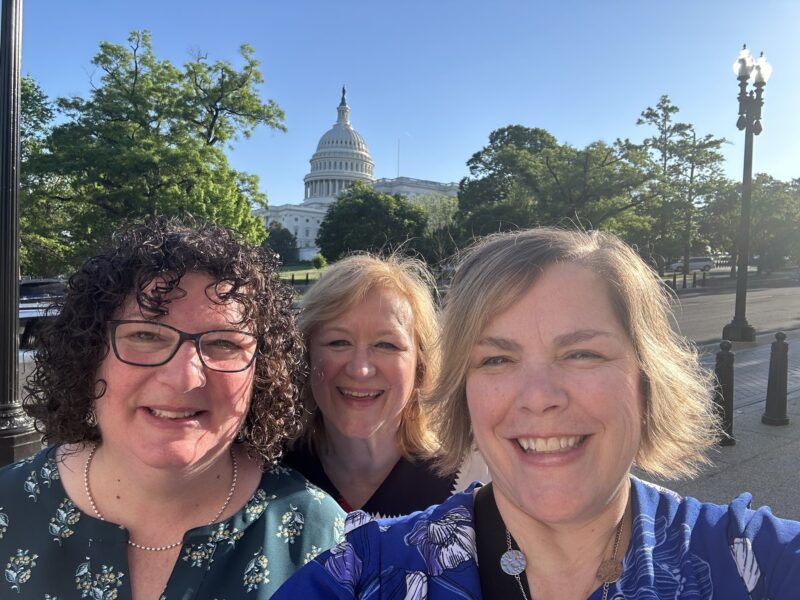
I&A Update: Ed Tech Advocacy and Policy Fly-In
June 2024 I&A Update: EdTech Advocacy Day On May 1, 2024, three members of our Influence and Advocacy Committee—Jenn Judkins, Colleen Terrill, and Karen Winsper—along with AJ Cote from DESE’s Office of Education Technology, took on the task of advocating for essential changes in educational technology. The team participated in the annual Ed Tech Advocacy and Policy Fly-In event, co-hosted by CoSN, ISTE, SETDA, and SIIA. This event brings together colleagues from various states, school districts, and ESAs, as well as members of Congress, key congressional staff, and education association leaders. They gathered in Washington DC to discuss critical topics such as cybersecurity, student data privacy, E-Rate, closing the homework gap, and other important educational technology issues. In the morning, the team joined leaders from the hosting organizations, other educators, vendors, and policymakers to prepare for the advocacy efforts. They met with staff from Representative Auchincloss’, Representative Trahan’s, and Representative McGovern’s offices as well as senior staff from Senator Warren’s and Senator Markey’s offices. The team emphasized the need for strong student data privacy measures, full funding for Title II and Title IV grants, enhanced cybersecurity, expanded E-Rate access including coverage for cybersecurity measures, and responsible AI usage. This year's event provided a unique opportunity to discuss how digital learning is a key element in creating equitable and effective education in a post-COVID world. The team's participation showcased the importance of collective action in achieving tangible progress toward ensuring every student has access to quality education in a digitally advanced setting. To learn more about key points from the event please click here. Visit the MassCUE Influence & Advocacy Committee page to learn more about our committee and how to get involved.
Continue reading -
I&A Update: Tools to Develop a School Safety Plan
May 2024 I&A Update: Tools to Develop a School Safety Plan For those who aren’t aware, the Cybersecurity and…
Continue reading -
I&A Update: Support the Affordable Connectivity Program
April 2024 I&A Update: Support the Affordable Connectivity Program EducationSuperHighway continues to work to close the digital divide…
Continue reading -
I&A Update: Changes to the Kids Online Safety Act
March 2024 I&A Update: Changes to the Kids Online Safety Act Future Privacy Forum (FPF) recently shared information on the changes…
Continue reading -
I&A Update: Computer Science Graduation Requirement?
February 2024 I&A Update: Computer Science Graduation Requirement? Share your Input. Should Massachusetts include computer science in high school graduation requirements? The…
Continue reading -
I&A Update: A New Age Verification Proposal
January 2024 I&A Update: A New Age Verification Proposal Meta is pushing for rival tech giants such as Google and Apple…
Continue reading -
I&A Update: State Legislators Consider Bills on Technology and Data
December I&A Update: State Legislators Consider Bills on Technology and Data The MA Joint Committee on Education met on October 30,…
Continue reading